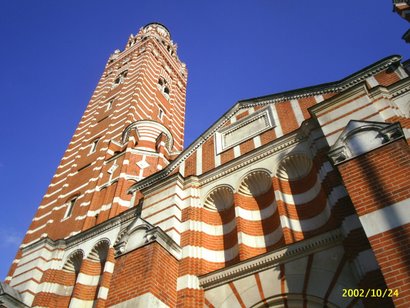
The highlight of the Congress of 1908 was the procession on the afternoon of Sunday 13 September. It also proved to be the most controversial aspect. Arrangements for the procession of the Blessed Sacrament had been made with Police, who had approved the route through the streets around the Cathedral.
 However, on Thursday 10 September, Cardinal Bourne (above) received a private communication through Lord Ripon from the Prime Minister, stating that the Procession might not take place. The Cardinal responded that, at this late hour, it was impossible to change the arrangements, and that he certainly could not do so in response to a private communication. The Prime Minister, Mr Asquith, insisted that the procession could not take place, but also that his communication was confidential and could not be published.
In response, Cardinal Bourne telegraphed the Prime Minister: "I have decided to abandon the ceremonial of which you question the legality, provided that you authorise me to state publically that I do so at your request."
 Only on Saturday morning came the response of Lord Asquith (pictured above): "His Majesty's Government are of the opinion that it would be better in the interests of order and good feeling that the proposed ceremonial, the legality of which is open to question, should not take place."
The Government's decision appears to have rested on two considerations. The first was of public order, and a feeling that the atmosphere of London in 1908 was not such as to tolerate such a procession. However, the Commissioner of Police made it clear that, as far as he was concerned, there was not the slightest objection to the proposed procession on the grounds of public order.
The second reason put forward by the Government was that the Procession would contravene the provisions of clause 26 of the Catholic Emancipation Act of 1829, which permitted Roman Catholics to exercise their rites and ceremonies in their places of worship, but stated that "if any Roman Catholic ecclesiastic, or any members of the Orders, Communities or Societies .. exercise any of the rites and ceremonies of the Roman Catholic religion, or wear the habits of his Order, save within the usual places of worship of the Roman Catholic Religion .. such ecclesiastic or other person shall forfeit for every offence the sum of £50." This (according to the Government) did not allow for a public display of Catholic ceremonial.
 It is interesting that the reaction of the Press was almost wholly unanimous in denouncing the actions of the Government as high-handed and unneccesary. The Daily Telegraph wrote in terms of "the strongest condemnation of the conduct of the Government. They have once more displayed their characteristic weakness and irresolution, the susceptibility to pressure, and their readiness to make concessions to the clamour of a few extremists." The Times congratulated the Cardinal and organisers for "their good sense in changing their programme at the last hour. We cannot extend our congratulations to the Government. They have blundered conspicuously, and if order has been preserved, this is not ascribable to them."
 Accordingly, at 3 o'clock on Sunday afternoon, Solemn Vespers were sung in the Cathedral, and an hour later the procession formed - without the Blessed Sacrament; a fact which, according to the Tablet, filled the great mass of faithful who had come to participate with 'disgust and disappointment'. However, at Cardinal Bourne's instruction, ecclesiastics, if not allowed to wear liturgical vestments, were to wear their ritual robes. The Tablet describes the extraordinary scene that unfolded in the streets around the Cathedral:
 "About 800 servers of the Guild of St Stephen emerge from the Cathedral, and are greeted with continued cheers which grow in volume as canons in purple, the Metropolitan Chapter in their robes of bright scarlet, the Byzantine fathers with their long beards, black habits, and grave and stately bearing; abbots, bishops and archbishops with their chaplains in varied purple. But now comes the Cardinal Legate, tall above the tallest, bearing the bright scarlet of a Cardinal, a long train borne behind him and eight Peers of the Realm forming a guard of honour, and the moment of his appearance is the sign for tumultuous cheering. The appearance of the other Cardinals is the signal for another demonstration. Each in his Cardinal's robes, with train bearer and chaplain, making a blaze of scarlet as he passes, is cheered to the echo. A Master of Ceremonies followed by an Archbishop in cappa magna heads a seemingly endless line of Monsignori, generals of religious orders, provincials, superiors, and priests secular and religious. through the neighbouring streets, Ashley Gardens, Rochester Row, Artileery Row, Francis Street, back to the Cathedral, the procession moves, accompanied by tumultuous cheering. here are seen closing the procession men from Preston and Leicester in regalia, students of Louvain, the Brothers of the Little Oratory in their habits, Brothers of the Servite Guild, members of the Guild of the Blessed Sacrament, and, an interesting feature, a company of Portuguese sailors from the liners at Tilbury."

The thought of eight Cardinals in full cappa magna processing through the streets creates an extraordinary vision! Upon returning to the Cathedral, Benediction was given by the Cardinal Legate from the open balcony, to the sound of trumpets. The vast crowd fell silent, but then a great cheer broke out.
"It was" records the Tablet,
"a spontaneous greeting to Jesus Christ in the Blessed Sacrament. it was a splendid if unconventional act of faith."
One suspects that Cardinal Bourne and the organisers of the Congress had underestimed the residual hostility to Catholicism in the nation - a fact that still takes Catholics by surprise in our supposedly tolerant society. During the Procession, there were some scuffles and
"some ugly rushes were experienced before the procession passed." At one corner there was another hostile element, but "
here 200 Brothers of the Little Oratory, in their robes, had taken up position and when the pressure came, the manner in which they held the ground was a revelation. Linked arm-in-arm, they stood in a solid phalanx, and not all the strain from the back could make them budge an inch."However, the Government, who (it seems) only realised the nature of the procession at the last moment, acted more unwisely. At the previous Eucharistic Congress in Germany, where there was a similar prohibition on public Catholic worship in force, the German Government had suspended its provisions to enable the Blessed Sacrament Procession to take place. In Britain, even the Government's closest supporters had to admit that their actions betokened a lack of toleration that portrayed Protestantism in a poor light. The Daily News complained;
"Protestantism in England is not so feeble as to need such weapons." The result, inevitably, was the undermining of the Government's own case, and the clear view that such restrictions upon Catholic worship had no place in a modern society.

 We were able to visit the shrine of St Edward the Confessor, one of the very few intact medieval shrines in the country, where the Dean led us in prayer.
 Afterwards, there was a reception in the Jerusalem Chamber. The title of this magnificent room was a cruel joke for King Henry IV (his bust can just be glimpsed top right of the photograph above), of whom it had been prophesied that he whould die 'in Jerusalem'. His fond hopes of a crusade to the Holy Land were, however, misguided, for it was in this Jerusalem Chamber of Westminster Abbey that his dead body was laid out.


 Thessalonika (or, in modern Greek Thessaloniki) is Greece's second largest city, but unlike Athens has enjoyed an unbroken history as a major city. After its capture by the Turks in 1430, it remained a largely Greek city until the arrival of the Jews expelled from Spain by Ferdinand and Isabella.
 Its Byzantine remains are second only to those in Constantinople itself, and the mosaics and frescoes of its Churches, although they have suffered the ravages of time, represent some of the highest artistic treasures of the Eastern Roman Empire.
  In the 7th century basilica of Haghios Demetrios, patron saint of the city, are to be found some of the most beautiful mosaics I have seen, softening ikonic formality with a personal intensity. This is what mosaic work is all about. Above is the figure of St Sergios. The mosaic of St Demetrios with two children (below) may well have been presented by the parents of the children depicted, following a cure or a favour granted by the saint.

 Below, St Demetrios is shown with a cleric. An inscription translates: "Blessed martyr of Christ, care for the city you love, her citizens and guests."
 The nineteenth century Cathedral of St Gregory Palamas gives a breathtaking vision of a complete decorative scheme.


 Finally, in the apse is the eighth century figure of the Virgin, representing humanity redeemed through the sacrifice of Christ, celebrated in the Mass. This was a theme present in the apse of every Church I visited, and one we intend to copy in the apse of Westminster Cathedral.


