 A welcome return has been made to our TV screens recently by Doctor Who. For many of us, Doctor Who had been a formative influence in our childhood, as he fought his tea-time adventures with aliens across the universe, particularly with the sinister tin robots known as the Daleks. The Daleks, you will recall, are the curiously low tech alien foe of the Doctor, armed with a rubber plunger and bad sinuses. But for a child, it was all that was needed to make us squeal with terrified delight. I remember an exhibition about Doctor Who on the South Bank that was entitled "From behind the Sofa". To Dr Who fans, this title will need no explanation - for, it was famously from the security afforded behind the sofa that we followed his adventures. You know the feeling: you can't bear to look, but at the same time, you can't bear to tear your eyes away.
John the Baptist (to whom the Church turns our attention today) has always enjoyed the peculiar status of being both a deeply attractive, and a curiously abhorrent figure. From King Herod onward, throughout the history of the Church, people have felt the need to pay attention to him, yet can't bear what he has to say. This wild man, consumed by his mission, marching out of the desert looking like a manic, smelling like God knows what, castigated people even as he spoke poetry to them. And they flocked to him, to receive his baptism, to hear him condemning them - they couldn’t help themselves. King Herod was hooked, and protected him; John returned thanks by berating the King. Herod could only be tricked into getting rid of him, and then he wept bitterly.
 It's partly to do with curiosity; we all love eccentrics, we're interested in them - although we would never want to share a railway carriage with one.
But there's more to it. John the Baptist claims our attention because we recognize that we need someone like him - in our society, in our lives, our Church. Someone who doesn't compromise, who doesn't say the easy thing, who makes us think, who challenges what we hold for granted. We are over-familiar with those in public life who are anxious to curry favour, win votes - in Church and State. We have seen conviction, in public life, replaced by careerism and opportunism.
Just occasionally, don't we want someone to say, "This is what I think - and I won't apologize for it!". Don't we want someone to say, "You are wrong!" Don't we want someone to make us feel uncomfortable with what we have grown used to - the luxury of our compromises. I suspect the Church is waking up to the need to speak out like St John – increasingly, the values of society are at odds with the true welfare of humanity. So Archbishop Nichols of Birmingham spoke out last week. What he said was not pleasant, but I think we know we needed to hear it.
Look at what John says - "Prepare a way for the Lord in the wilderness!" 
It's the last direction you'd expect God to come from! The Temple, yes; the church, the city. But the desert? From the start John puts us on the spot: if we only look where we expect to see Christ, we'll miss him, because he is greater than our preconceptions. God shocks us into a new awareness. He does that from the very moment he is born in - of all places - a manger in a stable. John the Baptist is the first wave of God's shock tactics, by his very appearance and behaviour - a behaviour many would call anti-social.
We need a John the Baptist figure, not just in our society, but in our lives - and in our Church. Our faith and our opinions cannot be healthy unless they are scrutinized, challenged. A faith that asks no questions of itself and its church is becalmed; it's no more relevant than a favourite pair of slippers, warming our cosy prejudices. A faith that is afraid to speak out, at the cost of popularity and even security, is no more than a slogan insincerely held.
We need John - but we're scared by him, too. For he may present us with answers we don't like. His questioning may undermine some cherished opinions. We may have to let go of some prized notions. We may have to let go of our immediate security. John was himself big enough to realise when his work was done, and to give way to Jesus: "I must decrease as he increases". It takes courage to let go like that, and we don't all have that courage. John is an uncomfortable figure.
But then, Advent is a time to feel uncomfortable. John's call to repentance will be taken up by Jesus as he begins his ministry: Repent, Change! Do things differently! Do we allow ourselves to be unsettled by the thought that Christ is coming? The manger in Bethlehem isn't all Christmas cards and chubby angels - it's also shocking, undermining. Do we allow John the Baptist to begin this challenge ? Do we reckon up the ways in which we fall below our own standards, and the standards of God? Once a year it is good for us to feel uncomfortable about that. And it is good to be mesmerized by the call of John the Baptist - a message we cannot bear to hear, and cannot bear not to hear.
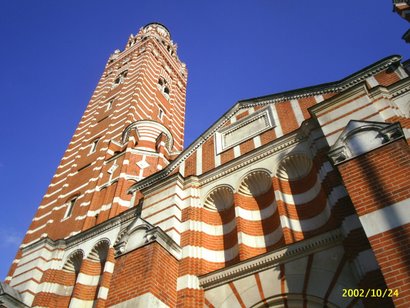
 The Cathedral is well, and imaginatively, illuminated at night. For a brief period in the early twentieth century, the Campanile was the tallest building in London, and Queen Victoria - allegedly - complained that it overlooked the gardens at Buckingham Palace.


 Two columns and their capitals; the original snapped a few years ago in Haghia Sophia (above), and our version in Westminster Cathedral yesterday (below). Although the colour does not convey it, the marble of the columns used in both churches is drawn from the same quarry: Verde Antique (Ancient Green) from Thessaly.