Pax Tibi Marce, Evangelista Meus
 The flag of St Mark, flying proudly on the terrace, proclaims my onomastico - my own Saint's day!
My love affair was, however, severely tested that 2003 pilgrimage, for as we approached the St Mark's Basin, where once the Doge's gorgeous state barge was once moored, the heavens opened monsoon fashion. The fragile tracery of the Doge's place disappeared into a grey blur, and our pilgrim group disappeared into a nearby shop for a mass purchase of umbrellas, thoughtfully supplied by the retailer at three times the normal price.
 Water was besieging us from below, as well. It was the notorious acqua alta, when a combination of high tide and scirroco wind drives the waters of the lagoon over the threshold of the city, and the sea floods into St Mark's square. Considering that this occurs more than fifty times each year, the Venetian solution is still curiously makeshift - duckboards raised on tressles, providing a precarious and lengthy passage above the icy water. The four Roman Emperors set into the corner of the basilica seemed to huddle against the weather and rising tide. Nor was the sea held back by the hand of God - it flooded into St Mark's, and access to the nave was over a temporary bridge across the flooded narthex. Whatever problems we face at Westminster, five inches of sea water is not one of them.
 Nevertheless, once inside, the magic works, the jaw drops, and we are transported to heaven. As at Westminster, it is the space that overwhelms, the massive volume of air seems as solid as the monumental masonry. The lower parts of the wall are encased in marble, familiar to us, of course, in our Cathedral's own Byzantine decoration. But above, where we know darkened brickwork, the domed vaults of St Mark's are coated with shimmering gold. Against their heavenly background, saintly figures glimmer, seeming to come and go. We are gazing, as the Byzantine artists intended, upon the vault of heaven. It is dimly lit - many would think too dimly - but this is part of the mystery. It occurred to me that ancient Venetians would never have had the benefit of today's high powered lights, and that even in the height of summer, the recesses of the basilica would have been shrouded in shadow. This is surely as intended. Byzantine churches do not bludgeon us, as in the baroque west, by pushing heaven into our faces. Here, all is subtlety and suggestion, an evocative glimpse for straining eyes.
 Will Westminster Cathedral ever look like this? Certainly not in our lifetimes - but the intention is there, and St Mark's is the nearest we can know to the finished effect. I am struck at how simple the designs are in St Mark's; the plans for our Westminster mosaics, such are they are, crowd the vaults and walls with complex scenes, with throngs of interacting figures. In Venice, figures tend to stand alone, starkly and powerfully against the vast golden background. Even over the apse, the solitary figure of Christ reigns tremendously amid a heaven of shimmering gold. Of course, individual figures need to be impressive figures, and the question of finding craftsmen of the calibre of the mosaicists of St Mark's is an acute one.
 As in our own Cathedral, there are intimate spaces within the vastness of the basilica. It was in one of these, the chapel of St Theodore, where we celebrated Mass, my nose mere inches away from the Madonna Nicopeia, the venerated ikon stolen from Constantinople, and carried before the Venetian armies into war. As I turned to our Cathedral pilgrims, their numbers swollen by pious or curious tourists, to share the Peace, I knew I would never forget the moment. To offer Mass was to become part of the story of St Mark's, linking this ancient basilica with our newer Cathedral, and the church throughout the ages. The weight of history was heavy, the sense of unity strong, and the magnificence of the surroundings made the promise of future glory seem very real. mm
mmmmmmmmmmmmmmmmmmmmmmmmmmmmmmmmmmmmmmmm
 Soon after Mass, we filed past the shrine of the saint himself. St Mark is buried in simple unadorned stone, but the Venetians have not been wanting in their devotion, having stolen the costliest relic in all Constantinople, the lavish and intricate altarpiece known as the Pala d'Oro, to adorn the evangelist's shrine. As I stood aside to offer a particular prayer to my namesake, I reflected that the solidity, beauty and subtlety of this basilica pay homage to the strength, beauty and subtlety of the first of the gospels. St Mark's is a monument to the superb pride and majesty of the Most Serene Republic, but also witnesses the hold of the gospel over a Christian people, and their ambitious desire to mirror the treasures therein in the most glorious creation of human hands.


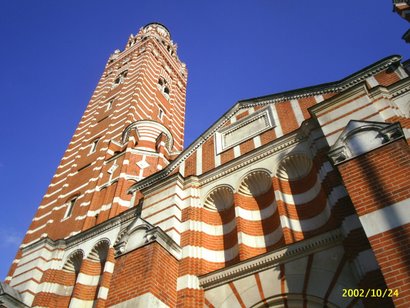
 Tom Phillips has been commissioned to produce a mosaic design for the chapel of st George, and an appeal to raise funds for it will be launched after Mass this evening. Tom has envisaged the vault of the chapel as a striking blue sky, filled with flames (which may also be falling leaves) each bearing the name of a martyr. The east wall above Eric Gill’s altarpiece will be filled in marble emphasising the sculpture, echoing the red and white stripes of the Cathedral exterior. At the summit of the east wall is an inscription from Luke 12; ‘I have come to send fire on the earth’ - the famous motto on the Martyrs’ picture in the English College at Rome.

 Tom Phillips CBE, RA is one of Britain’s foremost contemporary artists, winning wide respect in most aspects of the arts. He has collaborated with many great figures across the art world, and his paintings hang in major galleries - notably the National Portrait Gallery. Tom has already competed major commissions in the Holy Souls’ Chapel at Westminster Cathedral.
 St George was a Roman solider, put to death for his Christian faith about 320AD. His cult was brought to England by the Crusaders, and King Edward III made him patron of England in the fourteenth century. The chapel, which awaits its mosaic decoration, is a special place to pray for England, and for all those who have witnessed to their Catholic faith in our land - especially by shedding their blood in the troubled years when Catholicism was proscribed.
 In the centre of the floor is a rose, symbol of England; the rose motif is continued behind the altar and around the walls. Either side of the altar the red cross of St George is displayed on marble shields. Panels list servicemen who gave their lives in battle, and who are prayed for in the Cathedral.
  On the facing wall is a carving of St George, patron of England by Lindsay Clarke (who also carved the Cathedral crib figures, and the figure of Christ in the apse). It was added to the chapel in 1931.
 Above the altar is the last carving of Eric Gill, dating form 1947. It portrays Christ on the cross, not defeated and dead, but rather gloriously triumphant over death as priest and king. To his left stands St Thomas More, Lord Chancellor of England, and to his right St John Fisher, Bishop of Rochester. Both men were executed in 1535 for their refusal to deny the Supremacy of the Pope under king Henry VIII.
 In a shrine by the grill lies one of the Cathedral's greatest treasures - the body of St John Southworth, martyred in 1654 at Tyburn (now Marble Arch) for his Catholic faith. His body was retrieved from the scaffold and taken to the English College in Douai, France. Rediscovered after the destruction of the college, St John's body was brought to the Cathedral in 1930.
 The chair and kneeler in the chapel were made for the visit of Queen Elizabeth II in 1996 - the first time since the Reformation that a reigning monarch has attended a Roman Catholic service, and showing the journey that Christians in this land have made since the dark days of the Reformation.


 Many parishioners will remember Mgr Norris from his early morning Masses for his ready wit, and his encyclopaedic knowledge of the diocese. He is quite a unique treasure in this respect, having served as priavate secretary to Cardinals Griffin, Godfrey and Heenan. Below is a picture of him with Cardinal Godfrey, and the Duke of Norfolk.
 As his health failed, Mgr Norris was less able to take an active part in the life of the Cathedral. In earlier times, he was quite ready to don his robes - below he is seen with a younger Fr Langham, greeting the Queen's representative at the doors of the Cathedral.
