Sunday, 31 December 2006

O Taste and See how Gracious the Lord is.

Throughout Christmas, we have placed Sr Mericia's Nativity Cake in the centre of the table in Clergy House dining room, as an inspiration and as a work of art. Today, at the end of Sunday lunch, having admired her creation with reverent restraint, we asked her to come and cut it.
It required not just a steady hand, but a bold heart, to cut into the crib scene. Sister Mericia (one of the Portuguese sisters who works in Clergy House) showed no qualms.

However, nobody could quite bring themselves to eat the child in the manger.

The Holy Family

The mosaic from the chapel of St Joseph forms an appropriate heading for today's Feast. You may well feel that celebrating the Feast of the Holy Family straight after surviving Christmas en famille is a bit rich. Having withstood Christmas Day together, having put up with the in-laws and endured charades, having received a ghastly jumper and found that the alka-seltzers have vanished from the bathroom cabinet, rather than praise the family, you may want to murder them.

Families can seem, at times, like the brussels sprouts that come with the turkey: you've got to have them, but they leave you feeling dreadfully winded. And so, today, as we gaze at the serenity of the family scene in the stable, you may well be thinking that it is very far from the festive scenes of near riot at your house.
But perhaps they are not so far apart.

Families, remember, are big enough to survive Christmas. They do so because whatever rows or strains they throw up, what holds families together is far stronger, and far more flexible. Love. Love is not just reserved for cute carol singers on Christmas cards, nor cherubs floating above picturesque cribs gently powdered with snow. Love can be unbelievably tough. Families go through good times and bad. Families sometimes hang on by their fingernails. But families win through, because whatever bad news the file contains, the filing cabinet can contain it, and put it in a bigger context. Families are about love, and the price paid for love. And that's a very Christmas theme.

For the Holy Family, like any family, is a haven. Against the uncertainty and dangers of a confused world, the members of a family - especially children - find the secure space to grow, develop, and equip themselves for life. Just as the family of Jesus shielded him from the terrors of a violent world (in their case, the wrath of Herod), so within our families, children have the space to grow, to learn to love, and to respect love.

That doesn't make families easy - as many of you can testify. Families are real. If you belong to a real family, you don't need a priest or a bishop to tell you that the romantic stable in Bethlehem also contains a great deal of pain. That peaceful scene was won at the price of deep suffering by Mary and Joseph. It was their sacrifices, their pain, their courage in the face of fear, that enabled Jesus to be born amid peace, love and security. They would have done anything to keep him from harm. Any parent would.

Yet, can that cosy image that is so familiar to us (here, above, is a detail of the Cathedral crib) - the happy, blessed family of Jesus, Mary and Joseph - really be the pattern of all families? Most of our families are far less than perfect. Fewer of our families these days measure up to the traditional image. The Holy Family of Bethlehem seems an impossible ideal, too perfect!

But let us also look at what we know about that Holy Family. The story begins with Joseph discovering that his financée is pregnant. Next, the Government forces him to travel several hundred miles with his pregnant wife to his original home, where her child - who, we recall, is not Joseph's - is born in an animal pen. They are then forced to flee the country as refugees to Egypt. Later, we hear that when Jesus is 12, he wanders off from his parents on a trip to the big city. They don’t miss him for an entire day - an extraordinary feat of negligence - and when they do find him and tell him off, he answers back in terms that would certainly have earned a child of my generation a good hiding.

Later, at the Marriage Feast of Cana, Jesus seems to tell his mother to shut up. We read later in the gospels that his family thought he was mad, and when they came looking for him, would not let them in to see him.

I note all this not to shock, nor to be an iconoclast, but to point out the real truth of the Holy Family; that it is truly a pattern of families - but not just ideal, TV advert, get-everything right families. Jesus, Mary and Joseph are also the pattern for families where things do not go right, where problems seem to overwhelm, where relationships do not always work out. This was not a painted family carved in gilded wood; it was a real, human family with real human problems.

All of us, then, whatever the state of our families, however easy or difficult we find them, whether they fit the traditional image or don't fit it - we have a reason to rejoice on this feast. God chose to be born in a family. So all our families are blessed; Christ has made his home with us.

Saturday, 30 December 2006

Dampening the Spirits

When the brightest thing on the horizon is the McDonald's sign, then it really is a miserable day. This picture was taken at about 3.00pm, when the bright morning had turned into a damp and miserable afternoon. Thank goodness the interior of the Cathedral was bright and welcoming.

This photo of the Campanile reflected in the rainy Piazza is, admittedly, not quite as romantic as 'acqua alta' in the Piazza San Marco in Venice, but at least we don't have flooded crypts!

After the Storms, the Sun

An unusual view of the North transept, taken from Ambrosden Avenue.

Friday, 29 December 2006

The Beauty of These Days


Taken from the Grand Organ gallery, at noon.

Thomas of Canterbury

This morning, as is my custom, I celebrated Mass in the small chapel of St Thomas of Canterbury (also known as the Vaughan Chantry). Decorated with mosaics just two years ago, this chapel is a gem, with the walls and vault resembling the pages of a decorated medieval manuscript.

It is a great sadnesses that this Feast Day is no longer observed in the calendar, save as an optional memorial. It is hard for English catholics, this side of the Reformation, to realise just how popular St Thomas was in the medieval Church. At one time, the name of St Thomas of Canterbury (or Thomas a Becket) was daily on the lips of our forefathers; every person in this land would have been able to recite by heart prayers to him, or sing a few of the hundreds of hymns written to him. Many of us, in those days, would have made the visit to his celebrated shrine in Canterbury, where we would have mingled with Christians from all over Europe. For Thomas' fame spread throughout Christendom: there is an ancient Church to him in Spain, and another in Iceland; he is represented in near-contemporary mosaic in a Cathedral in Sicily, and in ancient fresco in Bordeaux. In sixteenth century Rome the entire College of Cardinals turned out for his feast day, and during my time as a student in Rome, the English College still kept his feast no this day with great ceremony and devotion.

Such was the fame of Thomas of Canterbury. How it has all changed now!

Perhaps it is not altogether surprising that he has gone out of fashion. Consider the reasons for his murder - not the sort of things we expect martyrs to lay down their lives for these days. St Thomas wanted to ensure the independence of the clergy from the secular law of the land - to which the king not unreasonably objected. He excommunicated two bishops who had crowned the king's son without his permission. This is a man who meddled in politics; we don't expect religion to go there.


Indeed, there are countless tales of his charitable deeds in life, and the miracles he worked after his death; but when all is said, the reason for his fame was not what he died for, but the very fact that he died. That an Archbishop should be cut down in his own Cathedral (as illustrated in the chapel, above) was an unthinkable blasphemy, an unforgivable crime. This was an epic tale, the struggle between a mighty king and his former friend and turncoat minister. No wonder he has provided fertile material for plays, films and poems.

But is that enough for prayer? Is that enough for us to hold a feast day to St Thomas? What does he say to us about Christian virtue, about faith, about holiness?

One can certainly point to Thomas' conspicuous charity; once the most powerful man in the kingdom after the king, as archbishop he lived simply and made generous provision for the poor. But then so did many others - even the King. Much can be made of the change in Thomas' personality, from grasping Chancellor to austere churchman. But this was his character - determined, efficient, thorough in whatever he did, whether politician or priest.

At the last, I think we have to look to the manner of his death, to see the heroic virtue that made him a saint. Like the man in the parable of Jesus who says at first he will not help his master, but later does so, Thomas deep down was faithful to the calling of God.

So it is, there are those who find faith hard, who struggle with the church, even with God. Those who have a complicated relationship with the Church and with the world, those who make mistakes, those in whome the strands of arrogance and piety are perhaps difficult to distinguish. But, at the end of the day, these same people are ready to give of themselves, to make sacrifices for God and for others.

I think this is where we find Thomas. He made many bad decisions, he mis-handled the king, and his motives and priorities were muddled. But at the heart of him was a deep and simple love for God, a belief in his calling, and a dedication that underpinned all he believed.

He is a patron for late-comers to the faith, those who are unsure of their commitment, of their ability to stand the test when it comes. He reminds us that God doesn't just want straightforward, uncomplicated people to serve him. God loves those who struggle, who fail, who are unsure of their motives. Standing alone in his vast Cathedral on 29 December 1170, faced with the wickedness of this world, Thomas shows the real source of holiness - a heart that trusts completely in the goodness of God.

Thursday, 28 December 2006

Holy Innocents' Day

There is a lovely atmosphere in the Cathedral during this Christmas season, and I enjoy the calmness of the great church - with many visitors simply walking around, or sitting silently. There is a sense, as ever, of prayerfulness and repose.

Wednesday, 27 December 2006

Nativity in Trafalgar Square


Strolling this afternoon to Trafalgar Square, I was delighted to see a crib nestling at the foot of nelson's Column. There has been much talk this year in the press of playing down the religious side of Christmas. This, then, was good to see.

I remember reading that the Trafalgar Square crib has been created by a Japanese non-Christian. The artist had an enjoyable time learning about the legends associated with Christmas, and then presented it in a Japanese idiom. Certainly it has the clean, minimalist look of a Japanese home (a tourist behind me said, "What? No straw!"). But it also has something of the renaissance about it. There's a clear hint at Piero Della Francesca's Nativity in the nearby National Gallery, even to the figure pointing to the heavens. Like Piero, the artist has placed the Christ child on the floor (a detail which is only just visible in the above photograph). The Madonna has the poise and tranquility of one of Pisanello's profiles, and the whole scene accomplishes a radiance and peace that is deeply moving.

A lovely detail is the figure of Joseph, lying alongside the child, and watching over him and (below) the three wise men who represent the three racial types of Africa, Asia and India.

Sankta Lucia

The photographer at the Swedish Church has sent us some photographs of the Sankta Lucia festival on 15 December, capturing the drama and beauty of the occasion.

For more stunning pictures, head to the gallery at the website of the Swedish Church

The Sacristy on Christmas Afternoon

Getting into our cappas is none to easy at the best of times. One false move, and a chaplain is garrotted.
However, at length all is in place, cords are fixed, and no one appears to be asphyxiating

Certainly our youngest chaplain, Fr Slawek, seems content.


And the procession wends its way in to the Cathedral for Solemn Vespers.

Monday, 25 December 2006

Away in a Manger

The beautiful crib at the High Altar dominates the Cathedral. Both simple and gracious, it creates a feeling of tranquil contemplation at the mystery of the Incarnation.


I was gratified at the number of people who greeted me after Midnight Mass, saying that they read this blog! May I wish you all, on behalf of all the Cathedral Chaplains, a happy and holy Christmas, and a blessed New Year.

Gloria in Excelsis Deo!

At midnight, following the Vigil of psalms and readings, the Cardinal intones the message of the Angels, "Gloria in Excelsis Deo" - Glory to God in the Highest! The Cathedral is flooded with eye-blinking light as the bells are rung (you can see our young ringers on the santuary steps), the organ bellows and trumpets sound for a thirty second 'strepitus' - a joyful clamour at the birth of our Saviour - before the Gloria in continued.

Sunday, 24 December 2006

First Mass of Christmas


A packed Cathedral for this evening Mass, especially aimed at young families. At this Mass, children are invited up for the blessing of the Crib

The Loneliness of the Long Distance Administrator

The Cathedral closed briefly this evening, to prepare for Mass. A chance to practice that fiendish tongue twister in the Christmas Proclamation. It is a marvellous text, reminiscent of those Classical texts in Livy where the year is set by reference to living and past rulers, and giving the occasion a sense of historical and universal significance. Here is the Latin text as sung, with the phase of the moon duly rendered:

Octavo Kalendas Ianuarii, crescenti Luna, Innumeris transactis sæculis a creatione mundi, quando in principio Deus creavit cælum et terram et hominem formavit ad imaginem suam; permultis etiam sæculis, ex quo post diluvium Altissimus in nubibus arcum posuerat, signum fœderis et pacis; a migratione Abrahæ, patris nostri in fide, de Ur Chaldæorum sæculo vigesimo primo; ab egressu populi Israel de Ægypto, Moyse duce, sæculo decimo tertio; ab unctione David in regem, anno circiter millesimo, hebdomada sexagesima quinta, iuxta Danielis prophetiam; Olympiade centesima nonagesima quarta; ab Urbe condita anno septingentesimo quinquagesimo secundo; anno imperii Cæsaris Octaviani Augusti quadragesimo secundo; toto Orbe in pace composito, Iesus Christus, æternus Deus æternique Patris Filius, mundum volens adventu suo piissimo consecrare, de Spiritu Sancto conceptus, novemque post conceptionem decursis mensibus, in Bethlehem Iudæ nascitur ex Maria Virgine factus homo: Navitas Domini nostri Iesu Christi secundum carnem.

Today, the twenty-fifth of December, under a waxing moon, unknown ages from the time when God created the heavens and the earth and then formed man and woman in his own image. Several thousand years after the flood, when God made the rainbow shine forth as a sign of the covenant and of peace. Twenty-one centuries from the time when Abraham, our father in faith, set our from Ur of the Chaldees; thirteen centuries after Moses led the people of Israel out of Egypt; about one thousand years from the anointing of David as king; in the sixty-fifth week according to the prophect of Daniel. In the one hundred and ninety fourth Olympiad; the seven hundred and fifty second year from the foundation of the city of Rome. The forty-second year of the reign of Octavian Augustus; the whole world being at peace, Jesus Christ, eternal God and Son of the eternal Father, desiring to sanctify the world by his merciful coming, being conceived by the Holy Spirit, and nine months having passed since his conception, was born in Bethlehem of Judea of the Virgin Mary. Today is the nativity of our Lord Jesus Christ according to the flesh.

Fourth Sunday of Advent

On this shortest possible fourth week of Advent, the four candles on the wreath express our joy and hope at the coming to birth of our Saviour.

In Joyous Expectation

We were all up late last night with preparations. The Cathedral is blessed to have such a good team, and each chaplain has worked hard to make sure the Cathedral and Clergy House are ready. With Christmas Eve as a Sunday, there will be little time to devote to these tasks, so Saturday was a useful and necessary space.

One job has been to set out the magnificant consecration sconces (left) - the twelve candles holders in the form of a hand holding a torch, which are set into the walls of the nave for major occasions. They give a wonderful feeling of the apostles leaning into the Cathedral, to light its way.

Sunday begins in the usual way, with four morning Masses (including the High Mass at 10.30) and Morning Prayer at 10.00. Somewhere over luncthime, however, the day transforms into Christmas Eve, with Solemn First Vespers of Christmas at 4.00pm. The first (family) Mass of Christmas will be at 6.00pm, replacing the usual 5.30pm and 7.00pm Masses.

As ever, this is joyous place to be, but also busy (the Confessional queues have been continuous), and one rather has a sense of 'coming to' at Midnight Mass, realising it has all arrived! For myself, many things to do today, including some music rehearsals. I have to practise singing the Christmas proclamation, which includes the toungue twister 'anno septingentesimo quinquagesimo secundo' (the seven hundred and fifty seveth year)! Better lay off the sherry at lunch!

Saturday, 23 December 2006

All is Calm...

The crib in St Joseph's chapel awaits the arrival of the Lord, and heralds the last few hours of tranquility before the frenzied activity of Sunday and Christmas Day. As far as the calendar, a Monday Christmas represents the second worst scenario, since Christmas Eve is a busy working day. However the worst secenario (Christmas on a Saturday) is very much the worst possible situation, since Boxing Day becomes a working day! Whatever, this work joyfully undertaken, for this is a glorious time of year.

This smaller of our two cribs has, for the first time, a magnificent new setting since the mosaics in the chapel were completed earlier this year.

Friday, 22 December 2006

A Foggy Day in London Town

Despite the fog that has settled in over the country, badly affecting transport, a weak sun did manage to peep through this afternoon, illuminating a corner of the Cathedral.

O little Town of Bethlehem

Last night, we held our annual Christmas Celebration, one of the major events of the Cathedral year. In Cardinal Cormac's absence, it was hosted by Bishop Stack.


The Cardinal is in Bethlehem, with the Archbishop of Canterbury and other religious leaders, on a pilgrimage of prayer to highlight the plight of the town of Our Saviour's birth - the Cardinal himself describes it as a 'pastoral visit to encourage the minority Christian community.' With the tense security situation, the tourist trade which has supported Bethlehem's Chrisitan community has collapsed, and the normally thriving town is almost empty. The Christian inhabitants are harassed and reduced to destitution, and many of them are emigrating. As an aside, the World Monuments Fund wishes to enlist the Church of the Nativity (above) among the ten most endangered buildings in the world.

It is hard to hear such news at any time, but at Christmas the plight of Bethlehem is especially distressing. It is not meant to be this way; as we mark the birth of our Saviour, the little town of Bethlehem should be the epitome of tranquility and beauty - the stuff of Christmas cards, not of news reports. Surely at Christmas, at least, it should sleep in heavenly peace.

Christmas is a time of make-believe; not simply because Bing Crosby tells us that we will all be watching to see if reindeer really know how to fly. There is a serious aspect to our make-believing, for we imagine that this really is a time of peace and goodwill, that the guns will fall silent, the starving will be fed, and the oppressed will be visited with open handed generosity. The truth is, of course, that as we celebrate Christmas, our world is still crucified by war and hunger, by oppression and violence. When the glow of Christmas fades, and the decorations are taken down, the world will look just as it did beforehand.

I remember visiting Bethlehem myself years ago, and being outraged that locals kept trying to sell us souvenirs when our group was attempting to pray at the Church of the Nativity. But then, this is as it always has been, for Christ was born into a world that had no time for him. Despite the angel glory, society did not pause on the day of his birth, and men carried on their commerce with as much greed, pettiness and rage as ever they did. We celebrate our Christmas Day this year at a painful time for the world – even if in the cheer of our homes we don’t switch on the radio to hear it. Much as we adore the Christ child, the rest of the world will scarcely take note.

But Jesus never came to impose himself in that way. So fully did he insert himself into our sinful world, that throughout his life he allowed himself to be the victim of events. This is a God who does not, by and large, tell everyone to shut up and pay attention. Rather, he is a God who quietly accompanies us into the darkest places of our lives. The very manner of his birth is a sign that he shares – rather than overwhelms – the darkest and most difficult moments of our world.

The pain and sadness all about us continues, even on Christmas Day, but we can no longer say that this sorrow has nothing to do with God. As God enters our world on Christmas Day, so he enters every aspect of it, joyful or sorrowful. As God was born into human suffering, so he is born in the life of every human who suffers. Jesus lay in a manger in a Bethlehem that, even in his day just as today, was afflicted with turmoil and strife.

We long for Christmas to be more than make-believe for our world. We wish that humanity would truly live the peace and joy of Christmas, and we join fervently in the words of the Carol, “O hush the din, ye men of strife, and hear the angels sing.” We must strive to make it so. But even as we do, we must recognize that something more important has happened. God is with us, however sinful we may be, born into suffering Bethlehem and our war-torn world; and that is not make-believe. That is real.
Thursday, 21 December 2006

Crib Wars

While the Administrator has opted for the trusted formality of his familiar italianate display in the Clergy House dining room, Fr Tim (under the heady influence of his recent pilgrimage to Our Lady of Gaudalupe) has gone all Mexican in the Common Room -

Wednesday, 20 December 2006

Wreathes around the Baldacchino

To celebrate the centenary of the Baldacchino this Christmas, we have wreathed two columns with garlands. Poor Tom, our electrician, ended up a ladder late last evening, threading the garland around the columns while avoiding the Christmas trees. However, with the help of Bernie, our handyman, a spectacular effect was achieved:

Tuesday, 19 December 2006

A Festive Note

Tradition has it that the youngest resident of the Clergy House must decorate the Christmas Tree in the Common Room. Usually, this means the Organ Scholar, and here Simon Lloyd sets about the task with great enthusiasm! Below, Simon stands before the finished product.

Monday, 18 December 2006

Light in St Andrew's Chapel

Light floods into St Andrew's chapel, revealing the exquisite designs in marble, and the arts-and-craft stalls by Ernest Gimson (1863 - 1919).

Sunday, 17 December 2006

The College of Cathedral Chaplains


Back Row, left to right: Fr Dwayne Bednar, Fr Michael Archer (Registrar), Fr Michael Seed SA
Middle Row: Deacon Richard Nesbitt, Fr Tim Dean, Fr Denis Sarsfield, Fr Slawomir Witon
Front Row: Fr Christopher Tuckwell (Sub-administrator), Mgr Mark Langham (Administrator), Fr Michael Durand
Photographed in the Lady Chapel this afternoon, wearing our winter fur Cappas. Another version below:

Gaudete!

A beautiful morning brought out the crowds to the Cathedral for the 10.30am Mass. This third Sunday of Advent is known as 'Gaudete' ('Rejoice!) Sunday, from the opening word of the Introit, or entry verse, but it also signals a joyful anticipation of the birth of our Saviour. The tone lightens - literally; the normal purple colour of the vestments and altar hangings is replaced by a lighter hue of rose. Below, Fr Christopher proclaims the Gospel at the 12.00 Mass.

Saturday, 16 December 2006

Third Sunday of Advent

Although a crib (we have two in the Cathedral) has been set up in St Joseph's chapel, we are not quite ready for the birth of the Lord. This weekend, St John the Baptist challenges us to accept the coming of the Lord in our lives as something that requires us to change and do things differently.


Soon after the National Lottery began, I went to the Post Office on Victoria Street one Saturday, on behalf of our syndicate of Cathedral priests, to buy my ticket. It happened I stood in the queue next to a Rabbi. For everyone else, this was just too much – I mean, what are the chances of a catholic priest and a rabbi being in there together? So we found ourselves the centre of attention, eagerly asked to give numbers by gaping punters convinced that their luck was in.

It’s one of those straws people clutch at. The Lottery – it would solve everything. Unlikely as it is that we will win, we still have that picture in our minds of what we would look like if we did. Horoscopes, lotteries, lucky charms – I can’t think anyone really believes in these things, and they’re all a bit of a laugh, but still we keep half an eye on them, because they answer that question within all of us, “What should we do?” And there is nothing new in that. Take John the Baptist. People thought their luck was in, that he was the talisman, the lucky charm, who would solve their problems. Perhaps deep down they knew he wouldn’t - not for them, anyway - but they still had to ask, “What shall we do?”

John was their horoscope, their lucky lottery ticket. They were desperate to hang on to him – indeed they thought they might make him their Messiah, their king. And John at once set about telling them that it isn’t that easy, that we can’t get simple solutions to the difficult problems of our life, at least, not ones that will let us off the hook. But that’s what we want. We wish that everything could be solved with a little good luck. Minimum effort; it’s what drives talentless youths to think they can shortcut their way to pop stardom at the push of a remote control button. And that’s what Christmas is all about – at least for most people. We’d like to solve the world with Christmas, as if Christmas makes all the difficult problems go away. So long as we’re a little bit nicer to each other, so long as we smooth over difficult relationships with an over-expensive present, so long as we sing about peace and goodwill to all, then we don’t really have to worry about doing it. No wonder Christmas is being celebrated earlier and earlier. It’s our lucky ticket, and it doesn’t demand much of us, really. Oh yes, there's the struggling with shopping bags through Debenhams, the squeeze onto the number 11 'bus on Oxford Street, but we’d prefer that any day over trying to stop genocide in Darfur, or trying to feed people starving in Zimbabwe, or trying to stop Jews and Palestinians killing each other. We know, deep down, that Christmas doesn’t really work, that come mid-January we’ll be back to our old miserable selves and the world will look as ever it did. But for these few weeks it’s nice to pretend that this is the solution, that this is all we have to do to make everything right.

John, however, stresses that there are no easy solutions to God, that he can’t be neatly added to our lives like a bauble on a Christmas tree. God is spiky; he leaves an unpleasant taste in the mouth. Indeed, with God you cannot have your cake and eat it – saying yes to God will mean saying no to something - or someone - else.

So, you might be moved to complain, there goes God again, demanding we turn our lives upside down for him, demanding that we upset our friends, demanding that we spoil the party. Why does it have to be so difficult to find the answers? Why does God have to spoil the party? Why is it all so complicated?

The reason is found in the second reading, and it is a reason as shocking as anything God has to say. God wants us to take our faith seriously, to risk all the ridicule and difficulty it brings, to struggle to follow his law, for one simple reason. He wants us to be happy.

Perhaps that sounds ridiculous. Like the headmaster telling the pupil whom he’s about to cane that this is for his own good. Like the condemned men in olden days who had to thank their executioners. But in fact, God is making perfect sense: there is no rule, no law, no demand made by God that is its own justification. Everything God asks of us serves one purpose – our happiness. St Paul has God emphasise this; "I repeat - what I want is your happiness." A real happiness, that is, answering our deepest needs and all that question that is forever at the back of our minds, “What should I do?” It is a real, and not an abstract or pious, happiness that comes from knowing we are free, truly free, to become who we should be. Such happiness (which doesn't exclude the lighter form of happiness!) is worth the struggle, the sacrifice, the difficulties. Such happiness is worth an awful lot more.

This weekend's gospel contains a challenge to each one of us. The challenge is, to walk to the manger on Christmas day and to ask myself, “What should I do?” And I can choose – to see it as the signal for a party. Or to see it as a call to change my life, a change which will require taking seriously the demands of my faith, but which also promises my happiness, a happiness for ever in the Lord.

Sankta Lucia, ljusklara hagring

This evening, we celebrated the Swedish festival of Sancta Lucia in a packed Cathedral, the first time that we have been host to the Swedish Lutheran community in London. The feast of Saint Lucy is rooted deep in the Scandinavian consciousness - one would like to think it a relic of Catholic trading links and their medieval past, but it seems to be relatively recent; within the last 200 years, the Hymn to St Lucy (translated from the Neapolitan song 'Sancta Lucia') has become popularised in Sweden. However, the Swedish ambassador, HE Mr Staffan Carlsson (below) made the point that this feast does unite Sweden's Catholic history with its Lutheran present.

The Olaus Petri Choir from Orebro was flown in to sing - an impressive group of talented young male and female choristers, which has gained a national repuitation in Sweden for its music. The highlight of the ceremony called for the Cathedral lights to be dimmed, as the young choir, robed in white and carrying candles in the vast darkness of the nave, processed from the back of the Cathedral to the sanctuary. At their head was the young girl chosen to play Lucy - her head wreathed in a crown bearing five candles (St Lucy is the patron saint of eyesight, and thence, of light).


It was a memorable and beautiful sight, and something previously utterly unknown to us. To the 2,000 Swedes in the Cathedral, however, it was clearly a most important event that linked them to their home and their loved ones, and their own childhood Christmases.

I wondered if the five-candled crown related to the headress of the Bridgettine Sisters, founded by St Bridget of Sweden, and neighbours of ours at the English College in Rome. Here is the redoubtable Mother Tecla wearing her headress:

Sankta Lucia was a truly beautiful service, showing that the cult of St Lucy transcends cultures and denominations, and enables us to shine forth together, Catholic and Lutheran, with the light of the gospel. Jul, Jul, Stralande Jul!

Friday, 15 December 2006

A Beacon in the Darkness

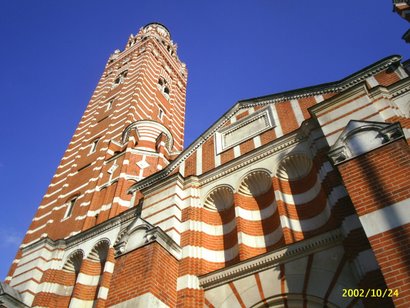
The Cathedral is well, and imaginatively, illuminated at night. For a brief period in the early twentieth century, the Campanile was the tallest building in London, and Queen Victoria - allegedly - complained that it overlooked the gardens at Buckingham Palace.

Thursday, 14 December 2006

God vs Mammon?

I was talking last evening with some friends about the photographs from yesterday's post, and the challenge they represent. The juxtaposition of Cathedral and shopping/leisure complex goes to the heart of the major question for the church in our times - how to proclaim the gospel in our modern world? I am struck at the way that Westminster Cathedral does not shelter within a secluded close (like other Cathedrals), but rather intrudes into the business and preoccupations of Victoria Street. It helps make Christ present in a secular world - someone once described Cathedrals as 'liminal', that is, thresholds between the secular and the divine.

But how to bring people across that threshold? One solution is to adopt a position of opposition to the world, proclaiming spiritual values that deny those of society, and to condemn (in our instance) the building on the other side of the street as an abomination. There is much that would tend to push us in this direction; the over-commercialising not just of Christmas but of human life; the attitudes to wealth, possessions and wordliness that the shops represent and help create; the dehumanising of interpersonal relations. The Church must stand up and stand out, and echo the call of the Lord for his people to repent, to change, and to live a different life.

But I also feel this is an over-simplification. It is striking how Our Lord sent out his disciples. They were ill-prepared; no purse, no haversack, no staff. Our Lord did not want his disciples to go forth into the world with their minds made up, and their preconceptions already formed. He wanted them to be open to what they would find, challenging it where necessary, but also interacting with it and, indeed, loving what is good about it.

For this reason, I am rather excited about Cardinal Place and the goods and lifestyle it has on offer. There is much there to praise; the compex has created a village, a community, that has the potential to enhance, and not destroy, human relationships; in our Catholic tradition, society is good, and makes God happen to people. Technology and innovations can be (when seen in the correct light) a hymn of praise to God. The vast array of goods on display can be a testimony to the grace of God working through human genius.

Our Catholic sacramental tradition proclaims that the work of human hands can co-operate in the divine work of salvation, and that God uses material things to become channels of his grace. Most famously, we think here of bread, wine, oil, and water. But viewed in the right way, the whole range of goods created by human ingenuity and imagination can be sacramental. The produce of the modern world is a wonderful testimony to gracious gift of God that works through our humanity, rather than over it. Of course, abuses abound. From the internet to microwave ovens, technology can be used for good or ill. But the potential for good is there, and this is where the church must be. It is a difficult task, fraught with dangers, but it is also exciting and life-giving.

Perhaps here is where I locate the role and spirituality of the secular (or diocesan) priest, a spirituality that is to my mind hardly explored in the Church. The secular clergy live not apart from the world, nor following a rule that preserves them from the world. They live out their vocation in society, worrying about many of the things that concern most people, chatting to people in the queue at Sainsburys, keeping up with episodes of Eastenders. A diocesan bishop was once asked what his prayerbook he used, and in response held up his diary - that is his life of prayer. Our task is to challenge the world, or course, but also to promote a healthy esteem for the world and its goods, and allow people to experience God in their lives, not apart from them.

Tuesday, 12 December 2006

From Cardinal Place

Some images taken this evening from Cardinal Place - the new arcade of shops and offices that has been built across from the Cathedral. For the first time, it is possible to observe the Cathedral from a distance, and I find the juxtaposition of old and new, spiritual and secular, very exciting and challenging.

Cardinal Place has made a considerable difference to this part of London. Victoria has been despoiled by '60s and '70s office blocks, which are now nearing the end of their life. Redevelopments such as Cardinal Place will transform this area in the next ten years.

For the Cathedral, it provides and opportunity and a challenge; Cardinal Place is a modern cathedral - a steel and glass temple to fashion and commerce. Much about that is good, but it raises the stakes for us, and asks us to find new ways of proclaiming the gospel. How do we express, in this context, that there is a spiritual basis to all of our activity?

Confessions at the Cathedral

On Thursday, December 14, there will be a Penance Service at the Cathedral at 6.30pm (immediately following 5.30pm Mass), with opportunity for individual confession. All the Cathedral chaplains will be present. This is is a wonderful opportunity for a personal and spiritual preparation for Christmas.

Of course, Confessions are also heard throughout the day, every day 11.30am - 6.00pm, and from next Monday 18 December, 9.30am - 6.00pm.

Sunday, 10 December 2006

A Voice that cries in the Wilderness

A welcome return has been made to our TV screens recently by Doctor Who. For many of us, Doctor Who had been a formative influence in our childhood, as he fought his tea-time adventures with aliens across the universe, particularly with the sinister tin robots known as the Daleks. The Daleks, you will recall, are the curiously low tech alien foe of the Doctor, armed with a rubber plunger and bad sinuses. But for a child, it was all that was needed to make us squeal with terrified delight. I remember an exhibition about Doctor Who on the South Bank that was entitled "From behind the Sofa". To Dr Who fans, this title will need no explanation - for, it was famously from the security afforded behind the sofa that we followed his adventures. You know the feeling: you can't bear to look, but at the same time, you can't bear to tear your eyes away.

John the Baptist (to whom the Church turns our attention today) has always enjoyed the peculiar status of being both a deeply attractive, and a curiously abhorrent figure. From King Herod onward, throughout the history of the Church, people have felt the need to pay attention to him, yet can't bear what he has to say. This wild man, consumed by his mission, marching out of the desert looking like a manic, smelling like God knows what, castigated people even as he spoke poetry to them. And they flocked to him, to receive his baptism, to hear him condemning them - they couldn’t help themselves. King Herod was hooked, and protected him; John returned thanks by berating the King. Herod could only be tricked into getting rid of him, and then he wept bitterly.

It's partly to do with curiosity; we all love eccentrics, we're interested in them - although we would never want to share a railway carriage with one.

But there's more to it. John the Baptist claims our attention because we recognize that we need someone like him - in our society, in our lives, our Church. Someone who doesn't compromise, who doesn't say the easy thing, who makes us think, who challenges what we hold for granted. We are over-familiar with those in public life who are anxious to curry favour, win votes - in Church and State. We have seen conviction, in public life, replaced by careerism and opportunism.

Just occasionally, don't we want someone to say, "This is what I think - and I won't apologize for it!". Don't we want someone to say, "You are wrong!" Don't we want someone to make us feel uncomfortable with what we have grown used to - the luxury of our compromises. I suspect the Church is waking up to the need to speak out like St John – increasingly, the values of society are at odds with the true welfare of humanity. So Archbishop Nichols of Birmingham spoke out last week. What he said was not pleasant, but I think we know we needed to hear it.

Look at what John says - "Prepare a way for the Lord in the wilderness!"
It's the last direction you'd expect God to come from! The Temple, yes; the church, the city. But the desert? From the start John puts us on the spot: if we only look where we expect to see Christ, we'll miss him, because he is greater than our preconceptions. God shocks us into a new awareness. He does that from the very moment he is born in - of all places - a manger in a stable. John the Baptist is the first wave of God's shock tactics, by his very appearance and behaviour - a behaviour many would call anti-social.

We need a John the Baptist figure, not just in our society, but in our lives - and in our Church. Our faith and our opinions cannot be healthy unless they are scrutinized, challenged. A faith that asks no questions of itself and its church is becalmed; it's no more relevant than a favourite pair of slippers, warming our cosy prejudices. A faith that is afraid to speak out, at the cost of popularity and even security, is no more than a slogan insincerely held.

We need John - but we're scared by him, too. For he may present us with answers we don't like. His questioning may undermine some cherished opinions. We may have to let go of some prized notions. We may have to let go of our immediate security. John was himself big enough to realise when his work was done, and to give way to Jesus: "I must decrease as he increases". It takes courage to let go like that, and we don't all have that courage. John is an uncomfortable figure.

But then, Advent is a time to feel uncomfortable. John's call to repentance will be taken up by Jesus as he begins his ministry: Repent, Change! Do things differently! Do we allow ourselves to be unsettled by the thought that Christ is coming? The manger in Bethlehem isn't all Christmas cards and chubby angels - it's also shocking, undermining. Do we allow John the Baptist to begin this challenge ? Do we reckon up the ways in which we fall below our own standards, and the standards of God? Once a year it is good for us to feel uncomfortable about that. And it is good to be mesmerized by the call of John the Baptist - a message we cannot bear to hear, and cannot bear not to hear.

Awaiting the High Mass

On a bright morning, on the Second Sunday of Advent. However bright it is, the lights seem to be on all the time! At the beginning of each Mass, a family comes forward to light two candles on the Advent wreath.

London Byzantine


Two columns and their capitals; the original snapped a few years ago in Haghia Sophia (above), and our version in Westminster Cathedral yesterday (below). Although the colour does not convey it, the marble of the columns used in both churches is drawn from the same quarry: Verde Antique (Ancient Green) from Thessaly.

Saturday, 9 December 2006

Christmas Vespers at Westminster Cathedral

This Cathedral Choir disc presents the Office of Vespers as it is celebrated on Christmas Eve in Westminster Cathedral. The chant on this disc is the golden thread which runs throughout the entire liturgy giving the Office a natural rhythm and inevitability as well as clarity of text and beautiful language; it is complemented here by motets and canticles by Thomas Tallis, Tomás Luis de Victoria and Heinrich Schütz, while Jean Langlais’s massive Fête for organ concludes the service. You can purchase the CD from the Cathedral gift shop, or online from Hyperion or Amazon.

Sub Tuum Praesidium

In honour of yesterday's Feast of the Immaculate Conception, an early morning glimpse of the altar of the Lady Chapel. The altarpiece, a rare full-length version ofaa'Our Lady of Perpetual Succour', was created by Robert Anning Bell RA in the 1920s. Around the mosaic is the text of the ancient prayer to Our Lady: Sub Tuum Praesidium confugimus Sancta Dei Genetrix; nostras deprecationes ne despicias in necessitatibus nostris (Under your protection we flee, Holy Mother of God. Do not ingore our prayers in our time of need).

The vault of the apse was created in 1930 by Gilbert Pownall. It is easy to see why the Lady Chapel is one of the most beloved areas of the Cathedral, for its present beauty, and its future promise - we hope one day that all the Cathedral will receive its mosaic covering and shine in glory like this.

The imagery on the apse vault is beautiful, and clearly draws upon the elaborate mosaics of the Church of San Clemente in Rome. The cross here is the Tree of Life, wherein Christ rules in majesty. From the tree spread vine branches, bearing fruit and giving rest to the birds of the air. At its fleet flow springs of living water. To the left stands Mary, patroness of London, standing before images of the Tower of London and Tower Bridge. Next to her is the archangel Gabriel, and then a host of saints particularly noted for their venenration of Our Lady. To the right of the cross stands St Peter, patron of Westminster (Westminster Abbey is more correctly the Abbey Church of St Peter), who stands before a mosaic representation of Westminster Cathedral.

At the Shrine of Our Lady

In the south transept is located this ancient statue of Our Lady. Created in the famous alabaster workshops of Nottingham, it dates from the early fifteenth century. While the majority of such medieval works in England were destroyed at the Reformation, this statue had been in France, although little else is known of its history. It was purchased at auction in 1954 (against keen bidding from the Dean of York Minster!), and enshrined in the Cathedral on 8 December 1955, the feast of the Immaculate Conception. The two simple candle sticks either side are also medieval.

Westminster Abbey possessed a famous medieval shrine to Our Lady, known as 'Our Lady of the Pewe' - perhaps a corruption of the French puissant, meaning powerful. Destroyed at the Reformation, the Abbey has recently restored an image of Our Lady of the Pewe, based on that in our Cathedral.

Our statue links Westminster Cathedral with the ancient faith of this land. It stands at the entrance to the Lady Chapel, beneath the Thirteen Station depicting Mary receiving her Son, in an area of the Cathedral fittingly called 'Mary's Domain.'

St Mark - the Lion in contemplation

St Mark (obviously, a favourite of mine) watches over the nave of the Cathedral from the pulpit, deeply lost in contemplating the Word. At his feet lies the the Lion that is the symbol of St Mark's powerful gospel.

Friday, 8 December 2006

W C Symons - a Glimpse of Heaven

Last evening there arrived in my office a wonderful cache of works by the artist W C Symons, comprising drawings and paintings for mosaics in the Cathedral. Symons was an old friend of J F Bentley, the Cathedral architect, and like him a and fellow convert. In 1899 Bentley asked Cardinal Vaughan that Symons should decorate one of the chapels. The result was the Holy Souls Chapel - yesterday's load includes preliminary sketches (left, below) for the finished altarpiece (right), where a Lamb and Cross are eventually replaced by the scarlet-clad figure of Christ in judgement.


I'll insert some text here
Although Bentley loudly approved of the finished design of the chapel it is hard to see how Symons achieved the architect's desire for 'a severe and very Greek style'. Installation of the Holy Souls mosaics took eighteen months, from June 1902 to November 1903.

In 1903, Symons submitted a proposal for the Blessed Sacrament chapel (above), with a striking depiction of the Trinity at its centre. It was rejected, and the chapel had to wait another sixty years for its decoration. In 1910, he received a commission for a mosaic of St Joan of Arc, funded by the Catholic Women's League. Yesterday's bundle contains a superb oil sketch (below) for this mosaic - considerably better, in fact, than the completed work (below, right) which stands in the north transept, near the Ambrosden Avenue entrance to the Cathedral.


I'll insert some text here

Symons also designed an image of the Holy Face, for the Sacred Heart chapel. The donor disliked it, but Symons refused to change it. However, Symons died in 1911, and in 1916 his mosaics were removed a new (and rather insipid) image of the Holy Face was installed. You can judge for yourself, with the drawing (below, left) and the actual mosaic (below, right)


I
I'll inset some text here also'll inset some text here
Finally, and appropriately for the Feast of the Immaculate Conception, the bundle of drawing contains several oil sketches for the Madonna and child, showing Symons experimenting with a Byzantine idiom, although clearly constrained by his Victorian outlook. None of these images was ever realised.


Althogether, both in terms of showing the evolution of Symons' completed designs, and in furnishing a glimpse ofwhat might have been, this is a fascinating addition to the Cathedral archive.

Balancing the Books

At last evening's Finance Committee meeting, we set budgets for 2007, and indeed they made for grim reading. In 2005, for the very first time in its history, the Cathedral was in the black - that is, it paid its way, and ended up with a decent operating profit at the end of the year. It looks as though we shall manage this again in 2006. But for 2007 the forecast is touch-and-go, and we shall be lucky to break even.

Even though we project an increase in revenue (and we have set ourself a target of a 5% increase in donations, which will be a considerable challenge), costs have spiralled. Unavoidable maintenance work and other factors will push our expenses well above 2006 levels.

Undoubtedly, the main item of cost is the music; a professional choir and musical tradition such as ours does not come cheaply. We also need to ensure that all our staff are paid acceptable salaries. In addition, the cost of running a large building (and its associated complex) is spiralling. Obviously, we have to keep the fabric of the building in good repair, but heating and lighting are expensive, and legislation (about, for example, fire detection systems) means further unavoidable cost.

There are, as ever, two necessary courses of action. Firstly, we must control expenditure. That will mean examining all our costs in detail to control outgoings; that is good practice anyway, and something we are morally obliged to do, relying as we do on money given to us. Here, the good news is that for the first time, detailed accounts and budgets are available to us (that's an actual photograph of them above!), and these will have to be scrutinised strictly.

Secondly, we must raise revenue, and this is something one does with a heavy heart. It means returning to our generous donors - those who contribute to the Cathedral weekly - and asking for more. It means serious high-level fundraising, which is hard and distasteful work. And it means increasing the charges for those who use the Hall, or hold Concerts in the Cathedral, as well as maximizing our commercial activities.

I've written before of the pain of all this; as a priest, one's concerns should ideally be spiritual, not fiscal. But Christians live in the world, and if one cares about the Cathedral and its mission (which I do passionately), then we have a responsibility to safeguard it for the present and future. Hard work ahead, but some good advice available - and prayers to boost our endeavours.

Thursday, 7 December 2006

Catholic Blogging

I discovered the Blog (as a concept) on a recent trip to America, where every Priest seems to read the formidable Whispers in the Loggia, a lucid and informative commentary on the American (and occasionally wider) Catholic Church. There are many Catholic bloggers in this country too, covering a range of views and aspects of the Church.

I met last week one of the most interesting of these, who conceals his identity as Joee Blogs (and I shall respect his anonymity). This blog is impressive because its author is, as he says, 'a young catholic Londoner, attempting to live and realise his vocation on the background of London, England.' It's not always an easy path, and the author frankly and bravely chronicles his own concerns - perhaps not everyone would agree with all his views, but one cannot but admire his openness and his determination to bear withess to his faith in the contemporary world. I commend it you - the link is as above.

Pastel Shades

With a monsoon thundering down outside, and a day of appointments ahead capped by a Finance Committee meeting, I offer a picture taken in the calm of yesterday morning. It shows the Grand Organ, masked from the Cathedral nave by wooden shutters so as to preserve a Byzantine authenticity (Byzantine churches do not have organs!). Beneath stand the two blood-red pillars that flank the main entrance; a reminder of the dedication of the Cathedral to the Most Precious Blood of our Saviour, through which we must pass to be saved. You may also glimpse an Eric Gill station of the Cross, and our fine statue of St Peter, proclaiming our unity with Rome. It is, however, the lovely hues of the marble, drawn from the ancient quarries that furnished Haghia Sophia, that delight the eye.

Wednesday, 6 December 2006

Parliamentary Links

Today sees two events that bear witness to our links with Parliament. At 5.30, we celebrate Mass in the Chapel of St Mary Undercroft. This medieval fragment of the old Palace of Westminster was orginally the crypt chapel of St Stephen's, long since replaced by the present Houses of Parliament. It is an enormous privilege to be able to celebrate Mass there, as we do several times a year for MPs, Peers and and staff in the Palace of Westminster. As ever, the Mass provides a link not just with the Church throughout the world, but in every age, and we recall our forefathers who once worshipped at Mass in this chapel.

To arrive at the chapel, one passes through Westminster Hall, whose layers of history are especially poignant for a Catholic: St Thomas More, the Cathusian Martyrs, St Edmund Campion and so many others were tried and sentenced here.

The second event is a concert given in the Cathedral tonight by the Parliament Choir. Composed of members and staff in both Houses of Parliament, it is good to know that they can, when required, sing from the same hymn sheet! Or oratorio sheet - tonight they are performing Mendlessohn's Elijah.

Tuesday, 5 December 2006

Choristers in the Telegraph

Today's Daily Telegraph features the choristers of Westminster Cathedral, as part of its campaign to choose readers' favourite carols.

A quiet moment in the Sacristy

Cardinal Vaughan keeps watch over his foundation ..

Children's Advent Carol Service

Above, the aftermath of the children's Advent carol service, with 2,500 school children filling the Cathedral. In the centre, you may make out the Cardinal, in choir robes, who led the service with wonderful enthusiasm. He was, however, almost upstaged by Larry the donkey ..

The carol service has become a regular feature in the Cathedral diary, and has steadily grown in popularity in the diocese. It is a great opportunity for children to begin their preparation for Christmas, and to meet the Cardinal. For us, it helps fulfil our desire that every catholic pupil of the diocese should visit the Cathedral - and have a memorable experience there. The hard work it entails (imagine returning the chairs to the nave evening Mass) is certainly worth the effort. More photos available on the Diocesan website

Monday, 4 December 2006

Preparations for the Children


As the sanctuary is filled with children preparing for the Advent Carol Service this afternoon, we are treated to the astonishing sight of the Nave cleared of chairs. We are expecting 2,500 schoolchildren from around the Diocese - and Larry the donkey!

Sunday, 3 December 2006

Advent Begins

The first candle is lighted on the Advent Wreath, expressing our hope in the Saviour who has come, and will come again in glory.

International Fiesta

Worshippers leaving our morning Masses were treated to singing and drums from a group from Ecuador, directing them to our International Fiesta. Arranged by Fr Bednar in aid of our twin parish in Guayaquil, Ecuador, the celebrations featured the talents of many of the ethnic communities in our parish. Food, dance and singing reflected the diverse community of Westminster, and helped create a sense of parish among the crowds who attend the Cathedral.

With music and dancing in the Cathedral Hall, a large crowd gathered to enjoy the festival, and support Blessed Mother Theresa Parish, and their programme for feeding hungry children.

In the foreground of the festively bedecked Cathedral Hall stands Fr Augustine Hoey, while our sub-Administrator, Fr Christopher Tuckwell, can be glimpsed, Roman-senator fashion, in the background.

Saturday, 2 December 2006

Vigil Mass, First Sunday of Advent

We welcomed Fr David Irwin, and his parishioners from St Peter-in-Chains, Stroud Green, to Mass this evening. It is always a delight to welcome parishes visiting the Cathedral.

Welcome to the Dean

This afternoon I had the privilege of attending the installation of the Very Reverend John Hall as Dean of Westminster. An important post for the Church of England, obviously, but also an important one for the Cathedral.

Relations between Westminster Abbey and Westminster Cathedral are strong, and have been characterised by warm friendships between successive Deans and Administrators. Situated close to each other in central London, it is natural for these two great churches to work together to bear witness to the Gospel together.

There is much that we can do at an official and unofficial level. On great occasions, the clergy and choir from either establishment travel down the road for formal services, while informal contacts are an important way of building fellowship and common cause.
Strangely enough, music has forged even closer links between Abbey and Cathedral, with a steady stream of talented musicians moving from one establishment to the other. The current Organist and Master of the Choristers at the Abbey, James O'Donnell, was previously Master of Music at the Cathedral; his successor here, Martin Baker, served as Organist at the Abbey - his successor there, Robert Quinney, was Assistant Master of Music here!

The new Dean has a background in Education, and served as Chief Educational Officer for the Church of England. Such a training will serve him well in communicating the gospel. We congratulate the Very Reverend John Hall, and assure him of our prayers, as we look forward to a fruitful collaboration in proclaiming our faith to the people of our city.

Flowers on the Sanctuary

A wonderful display of flowers at the High Altar, cheering up a dull December day.

Cleaning St Thomas

The marblework in St Thomas' Chapel (the Vaughan Chantry) is being cleaned, to provide a fitting counterpart to the newly installed mosaics. A plaque will be added to the floor of the chapel recording the interment of Cardinal Vaughan's body here last year.

Friday, 1 December 2006

Martyrs' Day

This is a day sacred to all those priests who studied at the Venerable English College in Rome: Martyrs' Day, when we commemorate those former students who died for their faith in 16th and 17th century England. According to a College tradition, when news of the death of a former student on the 'English Mission' was received in Rome, seminarians gathered in the Chapel before the Martyrs' Picture (above) to sing the Te Deum - the great hymn of praise to God.

The custom remains in Rome, where Mass in the College Church (above) today culminates in the Te Deum - and at various locations around England and Wales, where alumni gather to remember their martyrs, and their beloved College.

The Venerable English College boasts that it is the oldest English institution abroad. Founded as a Hospice for English pilgrims in 1362, it was converted into a seminary in 1576 by Pope Gregory XIII. Among its former students are many of the leaders of the Catholic community of England and Wales - both the first Archbishop of Westminster, Cardinal Nicholas Wiseman, and the present, Cardinal Cormac Murphy-O'Connor, were rectors of the College.

'Old Romans' in London gather today at Tyburn Convent, near Marble Arch, commemorating nearby Tyburn gallows where many of the College martyrs suffered, most notably St Ralph Sherwin, whose feast it is today. He was the first of the seminary's students to suffer, famously declaring that he was ready to die "Hodie quam Cras" ('today, rather than tomorrow'). The celebrant at Mass will be Bishop Paul Hendrick, auxiliary in Southwark, and we shall retire afterwards for a hearty Italian meal at St Mary Moorfields.

Father, we celebrate the memory of the Martyrs of the Venerable English College who died for their faithful witnessing to Christ.
Give us strength to follow their example,
loyal and faithful to the end. Amen

From Drains to Domes

Paul Gilpin, centre, retires from the Cathedral today as Clerk of Works - he is pictured here at his farewell party in Clergy House with his colleagues Tom Botting and Bernie Young.

The Clerk of Works looks after the facric of the Cathedral at both large and small scale. In practice, this means everything from surveying rooves and repairing heating systems, to changing light bulbs or disengaging roller blinds! In a vast and old building such as ours, the task of maintenance never ceases, and the Clerk's role is vital. For four and a half years, Paul has undertaken this essential work with skill and humour, and has become a key member of the Cathedral family. We wish him every happiness in his retirement.