 I was in Spain, recently, in the city of Seville. Its vast Cathedral is built over the former mosque and still employs the minaret as its bell tower. I wandered the streets early one morning, and came by chance upon this:

Which translates:
On 2 August 1802
was born in this house
Cardinal Wiseman
Archbishop of Westminster
Light of the Catholic Clergy
and glory of his homeland.
The esteemed Municipality
had this plaque erected
to preserve the memory of so illustrious a Sevillian.
1865
Despite the information on the plaque, the future Cardinal's baptism record and the journal of his father gives the date of birth as 3 August. He was baptised the following day in the Church of Santa Cruz by an Irish Capuchin, Fr James Ryan, and given the names of Nicholas Patrick Stephen.

The child's grandfather, James Wiseman, of Waterford in Ireland, had settled in Seville at the end of the eighteenth century where he was in business as a merchant. The Cardinal's father, also James, was the youngest son, and was also a merchant. Nicholas was the son of James' second marriage to Xaviera Starange, whom he had married in 1800 while on a visit to London.
James died in 1804, and Xaviera took her young family to Ireland. However, Nicholas retained memories of the land of his birth, and recalled the sailors coming ashore after the Battle of Trafalgar.
The image below, from Cardinal Wiseman's tomb in the crypt of Westminster Cathedral, shows his ordination on 10 March 1825.

Cardinal Wiseman died on 15 February 1865, and his tomb now stands beneath the high altar of the Cathedral

 Marcin Mazur was blinded by the light yesterday, as he set about taking photographs of the Crib for our literature over the Christmas season. Despite the Christmas decorations already appearing in shops, it proved very difficult to find Poinsettas in mid-October.
 It was all done in a few hours, and Marcin has taken some wonderful shots - of which more in their appointed season. The crib is now away again until Christmas, and the Poinsettas distributed among the ladies working in the Clergy House.
 As autumn settles gently on the Clergy House Terrace, I confess to being on tenterhooks; my citrus trees decided to burst into fruit in late August. However, given the appalling weather, they have been slow in ripening - but are now tantalisingly close.


 Geraniums seem to be indestructible, but the delicate nicotiana is still flowering.
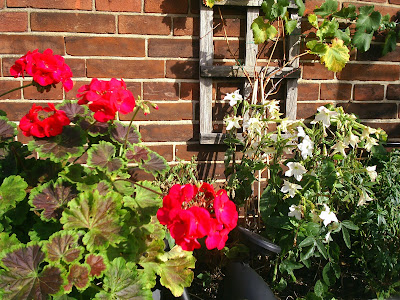 And, of course, the Coleus is Fabulous!


 Last night, Westminster Cathedral took on for a while the role of St Marco's in Venice, as the Cathedral Choir performed Monteverdi's sublime Vespers to a packed Cathedral. It was part of the South Bank festival, which this year is devoted to Venetian music.
 Although Claudio Monteverdi was born in Cremona, his name will always be associated with Venice. Originally composer to the court of Mantua, his Vespers of 1610 brought him to the attention of the Serene Republic, and in 1613 he was appointed conductor of the choir of San Marco – the Doge’s magnificent Byzantine basilica. There, Monteverdi established Venice at the pinnacle of European music; the scale and glory of his music reflects the conditions in the basilica, where he often placed choirs or soloists in opposing galleries to contrast their sound. Monteverdi died in 1643, and is buried in the vast Basilica of the Friari.


 It is worth quoting from the programme note:
 Tonight's performance does not take place in a concert hall, but in a sacred building - one full of architectural and devotional homages to the Virgin. In this modern concert performance, therefore, it is possible to detect undercurrents not usually present; the singing of the Office of Vespers is part of the Westminster Cathedral Choir's daily life, after all, and the pslam tones around which much of Monteverdi's music are based are still very much in the repertoire. Westminster Cathedral has much architecturally in common with St Mark's, and tonight's performance will use as much of the building as possible, taking its cue from the diverse combination of singers and instruments and the spatial separation implicit in certain movements.


 The celebrant was Archbishop Wesolego, who has responsibility for Polish migrants, assisted by Bishop Ploskiego, Bishop to the armed forces. We were fortunate that our own Fr Slawomir was able to act as interpreter and Master of Ceremonies.

